What is Stand Up Philosophy
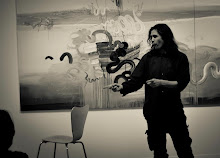
- matthew hammond
- This blog charts my attempts, in whatever way I can, and whenever I can, and as honestly as possible, to stand up for thinking - real thinking, whether in philosophy or politics, or maths - Because thinking needs standing up for!

Monday, January 14, 2013
Standing up for Freedom
Where does an idea as strange as Freedom come from? And how can one praise it, when we are as caught up in it as we are?
How indeed?
Perhaps the only way is to watch that idea decompose before us - to hear and see where many of its aspects come from, and to think then for ourselves how the ideas are then used: In short a backwards history of thought, where ideas fall apart, and are reworked - a history that we can then in our own minds, run forwards for ourselves, as we decide how we might also be free.
A history must start with the very modern paradox of how one lives in a society where if one is not necessarily free to do something, the thing is either illegal or the topic of anxiety; and then work backwards to re-find the potency of freedom itself.
The first piece tonight looks at Foucault's argument, which seeks to understand how society captures you without you being aware of it, and how that makes freedom so hard. The second piece is Deleuze's counter argument, and is a poetic conjuration of how the moment might set you free.
Full playlist
The Four Minute Foucault
Or the History of Sexuality, in an Introduction, three Arguments, and a Conclusion.
In his scintillatingly intense study, 'The History of Sexuality Volume 1: The Will to Know', Foucault not only attempts to persuade you that your sexuality is really not what you have been told it is, but also that even as you desire, you are plugged into a wider complex web of power, that defines our society. Foucault thereby turns our inmost feelings into a battleground of regulation and resistance. Freedom becomes then, if not about setting your mind free, then a matter of managing the exact way that the Power-Desire locus, defines what one is, and what one can think.
In this short piece the critical argument here, is turned into an intense performance, which summarises both the complexity, and includes the good humour of the original work.
Deleuze, - Becoming Heaccity:
This vivid piece is an adaptation of one short essay from Deleuze and Guattari's great ragbag of a book 'A Thousand Plateaus'. The study, uses art and imagery to try to show you how you might set yourself free in each and every moment, if only you have the courage to see it, and the commitment to live it.
This brief, and beautiful piece of writing needs to be understood as as much an invocation to freedom, as it is an argument. Deleuze is trying to show you how you are free, and not merely to tell that you are, a move which I attempt to capture in the performance.
Having set out the modern problem, we start to go back in time. First a hundered years (or so) ago, but this basic duality of freedom remains the same - but understood now in relation to the demise of god, and what it means to be 'from hope and fear set free'.
Neitzche: Kant, and how to 'think the thought that has Ne'ar been Thunk before'.
This piece was inspired by Nietzsche's hilarious deconstruction of Kant in 'Beyond Good and Evil'. Here he dismisses Kantian philosophy as mere word play, and theological smoke and mirrors. I have taken it as my inspiration, and blended it with famous details from Kant's life, to make this rumbustious story.
So is it time to
Think the thought that ne'ar been Thunk?'
or even
'Plunder that ponder thats ne'ar been plumbed?'
On a different and far darker tack, is Marx's version of a similar problem. What does it really mean, he asks, to live beyond God in a world of science?
The Three Minute Marx:
Or The dream of Marx in 3 thesis and a panic attack
This short piece attempts the impossible! Not only is it a short succinct summary of Marx's great work 'Das Capital', but also it attempts to make Marx radical and powerful again.
We then move back only a generation, and yet so much changes. God is still in heaven (just), and there is the argument that not only can one reconcile personal and political freedom, but it is necessary for both that one does so. An argument that will infuse the work of the next three philosophers.
Hegel: Or how Culture will Set you Free.
Hegel presents, albeit it a slightly idiosyncratic way, the clearest, and perhaps most persuasive argument, that only society can set you free. This argument is perhaps best made in the philosophy of Right, whose introduction is presented here. The performance attempts to recapture something of Hegel's unique lecture style, part introverted thinker, part messianic prophet.
Kant: What is Enlightment?
This is Kant at his critical and yet belligerent best. In the cause of freedom he argues, one must both question everything, but ultimately to conform the norms of one's day. To fail in either of these, Kant claims, is to risk that very freedom that we should cherish. Kant is therefore both the greatest of revolutionaries but also the most extreme of reactionaries: As modern audiences can find this position uncomfortable, please feel free to heckle - Kant will love it!
Rousseau, and the dark symphony for Freedom:
The first two books of the Social Contract.
This is one of those books, whose first opening, like certain pieces of music, we all know so well. And yet like a big symphony, the introduction, the first lines, are actually at odds with a lot of the rest of the argument in the work; an argument that takes one on a very strange journey, through freedom, to oppression. It is therefore a book that writes the history of so many revolutions, and yet does so before the revolutions have happened... It is a study which, like good music, is at once dark and light, and has gathered new power and new meaning across the two and half centuries since it was written.
Why Must One Worthy of Living in the Best of all Possible Worlds?
The next piece, is one of my favourites. It is from my second favourite philosopher, Leibniz, and amounts to a thesis defence of an idea which Voltaire hooted out of history, namely that this is the Best of all Possible Worlds. And yet, this mockery is so unjust - for the argument behind this doctrine is very subtle and carefully nuanced. In this piece I update Leibniz for modern ears, and give him a chance to answer Voltaire, and to try to invigorate an idea he held very dear.
We now jump back past the Reformation, to a world of fixed theologically sanctioned monarchy, and a somewhat surprising argument which appears to critique that world.
Thomas Moore and the pathway to Utopia.
The first book of 'Utopia'
In this very witty and radical text Moore, appears to question not just the assumptions of his day, but also of the ages that have followed it, as he sends up not only monarchs, and their desire for land, but also the Novo Homo, desire for wealth. He can do this by presenting the critique as traveller's tales, and putting it into the mind of a speaker whose position in society is unclear and complex. I attempt to capture that complexity, and the very modern alternative style comedy that infuses it, by performing this piece in two voices, that of Moore and the traveller Raphael, through whose interactions so much can still be said.
Now we jump a millennia and a half, over so much that could be said by Aquinas, Augustine and Ibn Sina. But for reasons of time, we will next pick up the story of freedom in a lament, written in Ancient Rome to the passing of its Republic, a lament that then formed the backdrop for so much that was then thought about freedom and the state.
The Valediction to Freedom
Or Cicero's 'Republic' as a speech
This piece seeks to present Cicero's central argument, in his book 'The Republic', as he might have best understood it, a speech made by his ghost. In his address Cicero will, not only present a summary of his book, but will also relate it to his own tragic end, and seeing both as precedents, make a direct appeal to us today. For he argues that we too, stand upon the fork of Fate, and on one side lies fear, and on the other only hope.
The final two pieces go right back to the origin of philosophy in Plato, and looks from a different perspective at the idea of personal freedom, and its consequences.
That is all very well for you Scocrates
Or Alcibiades' lament for love
This intense performance attempt to recapture something of one of the great moments in philosophy, but also in the history of freedom. Its inspiration lies in Plato's 'Symposium', the book that invented the word Philosophy. The highlight of that book might have been Socrates' great speech, where he attempts to show how love can set the lovers free. But just at the moment of Socrates' great appeal, his erstwhile friend Alcibiades, enters and is persuaded to give this very different account of their relationship. An account that is at once sobering and powerful, for reminds us that the freedom of one, is so easily another's dark prison.
The final piece for tonight is where one always needs to start and end in Philosophy. It is from Plato's Apology - and starts with the moment that Socrates stands up to make an appeal for his life, against trumped up charges. It is a moment of high drama, for no-one really knows whether, like so any others, Socrates will plea bargain, or whether he will fight, and if so how. A drama that caught the spirit of Plato, and which infuses so much of his writing and all the philosophical debates that have followed it. It is therefore one of the great Events, in whose light the Western Philosophical tradition of freedom was forged.
There is also a major role for the audience in this piece, so feel free to bury yourself in the part of the People of Athens.

Saturday, January 12, 2013
Hegel - to Mock or to Think?
It is one of the oddities of philosophy - how an idea can really grab you, and do so in spite of yourself. I am currently working on a piece on Hegel, who is never a philosopher I feel happy with - he is too verbose and too much the archetypical clever fool - the one people mean when they laugh at philosophy or think it pointless. All of which is true - and to read Hegel is to be perplexed and slightly annoyed - one wishes he says things more clearly (the really annoying thing is that he can - the start of the phenomenology of mind is wonderful, it is just a pity about how it then carries on though).
And yet, and yet there is something also wonderful about Hegel. Even as one dismisses his ideas, and laughs at his made up universal histories, and bizarre pompous formulas, something in him grabs you. He has a power to make you step out beyond yourself, and your normal experience, and challenges you to re-examine yourself and your life. You laugh at him at your peril therefore, for you might very well become the object of fun....
The game therefore of performance I think ought to be to capture something of this movement. The audience ought to start laughing at him, and then wonder if it is he that is laughing at them...
To see if I manage to pull it off come along to Taking the Mike on wednesday - or, alternatively there will be a video coming soon!
Wednesday, January 9, 2013
Why Going Backwards is the way Forwards!
Why are the Stand up Shows a backwards read through time? In a sense because for me philosophy is at its best at its cutting edge. What the show does is to attempt to get the moment of elation that is a good idea. More than that seeing that moment makes even very well known ideas feel exciting again, and vibrant. It also opens up strange links between ideas. Foucault might be habitually seen as opposed to the modern liberal consensus, but that does mean he is fundamentally opposed to Kant, upon whom that consensus bases its foundation, and with whom Foucault shares so very very much. It is this loop of Foucault-kant that presenting them in their moment of thought capture, and which is so much clearer if heard Foucault before Kant.
To go back in time, is to know where the ideas lead to, even as you are presented with them in their power and passion. It is therefore to be and feel the bitter sweetness of the history of philosophy - where ideas that promise so much, lead to odd places, and never were the thinker hoped. And yet it is the power of thought that these odd journeys do not matter. Indeed they is the point, ideas should open out to who knows what, for it is it that opening the world replies to them, and they are made what they then become. and it is reply to the immediate power of the idea, the structure of the show, the running backwards though time, tries to get at.
Wednesday, December 19, 2012
Performing in ones own voice
It is strange. I am am experienced performer, I relatively rarely get nerves, and yet last night I discovered something that does make me jumpy: Performing- in my own (or near to my own) voice, without a script or paper to work from.
I was practising intros for my standup show, trying to work out, why I am never that happy with how i frame pieces, a process one must get right with one performs the kind of material I do..
The piece I was doing was called -A Vindication of the Rights of Performance Philosophy, and took the form of a handbook to help one live beyond of the Death of God. It includes two or three of my more cherished maxims - about identity, freedom and redemption: All of which are difficult ideas to critique(which I kind of was) as they are so much a part of an individuals mental landscape, particularly to a poetry audience at the end of the night (after 10:30).
And yet it does feel good, as it is make me, in my introductions to take Standup Thought in new directions. It is allowing me, however scary, to make it clear to others how much of what I perform is my own voice (and how how belong to the thinkers I perform). This is absolutely necessary, and without this demarcation I know I am simply not doing justice to philosophy (or my own scholarship). i have therefore a duty make it work, and was pleased by the performance - given the difficulty of the hour, and the piece, I think it could not have been different.
But I will not give up, and next time will be better still, and there will be a next time very soon.... I just wish did not find it quite so terrifying!
Monday, November 19, 2012
An Idea for all Times
When you think about it, the history of philosophy is essentially a temporal monster, or a time-crime of the highest order; and performing mere exacerbates this fact.
Or at least it ought to be. Philosophy only has power (or separate existence) as its ideas speak to us here and now. And yet the same ideas have a history of their own, and what was more all its ideas were always peculiarly rooted in their own times : But this strangely does not matter. I mean Hegel might have thought history ended with the Prussian king, and Marx he revolution was tomorrow, but that does not undermined exactly what they say (any more than the minor Apocalypse undermines Christianity).
But this does not mean the ideas ought to be pulled apart from their history, or seen as logcal and so true and distinct from their times. On the contrary, their history, what they were solving, and how we feel about tt, is actually part of their identity, and infuses their reality for all time. To know them as powerful ideas now, is also therefore to re-conjure there history.
More than this, good ideas crystalise for us, that history so that in them it lives again - and in thinking them we feel its power and passion, as a thing gone, and get still present and vivd. The history of ideas is therefore not only a challenge to our conception of the here and now, as learning the history of the assumptions you simply accept makes you rethink them: but it is also the most vivid of historical romance, and one that really does put the thinker at the centre of the drama. You hear the ideas as they were, and as they are- and are caught up in the moment of their history, even as you feel that history in the moment.
I am currently working on a performance of Behemoth, Hobbes account of the start of the English Civil. It is a book shot through with the politics of his day (it was written in 1668, but then supressed until after his death), but also the memory of the politics of the generation before (it analyses 1640-1660), and has is its debates, echoes so much of what we think today. A good performance of it, ought therefore to let all this aspects out -- the audience ought to be back in time, even as they feel the power of the arguments today: To read and perform it is is therefore to breed temporal monsters, or to commit a crime against time.
Wednesday, October 17, 2012
Keeping up the pace
I have blogged before about that integral difficulty of standup philosophy: pace versus explication. That is go to quickly and the audience is lost, as you have said far far too little, but go too slowly, and you do the philosopher justice, but bore, then loose the audience. This dilemma is not only integral to the structure of each piece, but also unique to each performance. Take this piece. It was the end of a long evening of (very strong) performances. It was therefore far too late for most the audience to engage their brains. This meant there was no real point 'doing Plotinus' properly. It would not have worked. Plotinus is hard at the best of time to wrap your head around, even more so at the first hearing and almost impossible if that hearing is past ten, and everyone is tired... The performance therefore had to not be about explanation, so must as impression. I wanted the audience to get the idea that there was an amazing theory of time, a theory which is similar and yet so different for todays conception of it, in the third century AD. What is more I wanted the audience to get the idea that this theory was linked to St John's gospel, and combines a theory of physics with outright mysticism. Hence the piece has lost some of the subtlety of the original, and yet has I hoped kept much of its poetry and its power.
But judge for yourselves:
But judge for yourselves:
Wednesday, October 10, 2012
Jarring Time
One of the oldest theories in western thought, involves restitching ones notion of time, so that it is merely a participation within, or a mired reflection of being in something else. The reason why such an idea is so persistent is easy to grasp: It is so hard to think of time in the first place; so hard indeed one cannot even be sure that the analogies one uses to encompass it (be it -rivers or fabric, or mirrors) are not in fact the actual reality of what is being described in the first place. To think of time, almost (but not quite) always involves grasping that time in, or as part of, something else.What is more philosophies are defined by the way they define this participation.
The question therefore always becomes exactly how one understand this participation. Here there are perhaps three basic stratagems. The first one, which is usually attributed to Plato, argues that time is some kind of reflection of an eternity, and imperfect one at that. It therefore attempts to capture of difficulty of thinking time, by blaming times imperfection itself.
The second methodology was pioneered by Aristotle, and looks understand think time through something we all understand, and which necessarily involves it, namely movement. Time is the numbering number of movement - and so the way we grasp the difference it makes. So that while we cannot grasp time itself, we still understand what it is, and how it functions.
Finally one might understand time as participation in something other, something greater and enigmatic- be it the fabric of space-time or the participation in a 'One' beyond all difference. This latter move was poineerd by Plotinus (a third century AD thinker), who saw time as the way we were part of, and part in, the eternity of being, which was itself an expression of the singularity of The One that existed beyond all being. The theory argues that our being in time is our being in something else, something we cannot understand or comprehend (which is why we find it hard to think), a mind numbing idea, but one that came back strong at the start of the twentieth century, in the form of relativity. It is therefore a theory which in a sense we now all know of (even if we do not understand it), and for that reason alone, one well worth performing.
The problem of course then is how do you do it? how do you perform an enigma, that has confused two thousand years of thinkers? One could perform the confusion itself, but that never appeal to me. Far better to bring out the relationship with Einstein, but also to link the idea also to a wider fin de siecle feeling that wants time to mysterious. Plotinus will therefore appear as half Einstein, an abstract thinker of genius, and half sub-lovecraft writer, obsessed with what lies beyond the curving of our universe: He needs to be half wooly mystic, and half abstract thinker of great genius. A conjunction that is, I think is very interesting, as it gives novel way to explore how all abstract thought, relates to, feeds upon, and yet critically remains distinct from profound imagination. In Plotinus one can really see being a mystic is not enough in itself to be a scientist, a fact that might need relearning.
The game with this performance, and what will make it succeed or not is the voice of Plotinus. He must feel like Einstein on acid, as so get the audience to 'feel' they know him, even as his ideas overwhelm with abstraction, and carry one on the strangest of journeys, that is bamboozling, and yet strangely beautiful and even fulfilling. In short I need to get poetry of the ideas, in all their vivid glory right. If I can this piece will move beyond the humour it has to start with and that must run through it, and which carries the audience along, and become truly a 'glittering shard of sepulcral majesty'...
Subscribe to:
Posts (Atom)