When you think about it, the history of philosophy is essentially a temporal monster, or a time-crime of the highest order; and performing mere exacerbates this fact.
Or at least it ought to be. Philosophy only has power (or separate existence) as its ideas speak to us here and now. And yet the same ideas have a history of their own, and what was more all its ideas were always peculiarly rooted in their own times : But this strangely does not matter. I mean Hegel might have thought history ended with the Prussian king, and Marx he revolution was tomorrow, but that does not undermined exactly what they say (any more than the minor Apocalypse undermines Christianity).
But this does not mean the ideas ought to be pulled apart from their history, or seen as logcal and so true and distinct from their times. On the contrary, their history, what they were solving, and how we feel about tt, is actually part of their identity, and infuses their reality for all time. To know them as powerful ideas now, is also therefore to re-conjure there history.
More than this, good ideas crystalise for us, that history so that in them it lives again - and in thinking them we feel its power and passion, as a thing gone, and get still present and vivd. The history of ideas is therefore not only a challenge to our conception of the here and now, as learning the history of the assumptions you simply accept makes you rethink them: but it is also the most vivid of historical romance, and one that really does put the thinker at the centre of the drama. You hear the ideas as they were, and as they are- and are caught up in the moment of their history, even as you feel that history in the moment.
I am currently working on a performance of Behemoth, Hobbes account of the start of the English Civil. It is a book shot through with the politics of his day (it was written in 1668, but then supressed until after his death), but also the memory of the politics of the generation before (it analyses 1640-1660), and has is its debates, echoes so much of what we think today. A good performance of it, ought therefore to let all this aspects out -- the audience ought to be back in time, even as they feel the power of the arguments today: To read and perform it is is therefore to breed temporal monsters, or to commit a crime against time.
What is Stand Up Philosophy
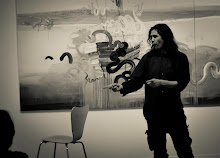
- matthew hammond
- This blog charts my attempts, in whatever way I can, and whenever I can, and as honestly as possible, to stand up for thinking - real thinking, whether in philosophy or politics, or maths - Because thinking needs standing up for!

Monday, November 19, 2012

Wednesday, October 17, 2012
Keeping up the pace
I have blogged before about that integral difficulty of standup philosophy: pace versus explication. That is go to quickly and the audience is lost, as you have said far far too little, but go too slowly, and you do the philosopher justice, but bore, then loose the audience. This dilemma is not only integral to the structure of each piece, but also unique to each performance. Take this piece. It was the end of a long evening of (very strong) performances. It was therefore far too late for most the audience to engage their brains. This meant there was no real point 'doing Plotinus' properly. It would not have worked. Plotinus is hard at the best of time to wrap your head around, even more so at the first hearing and almost impossible if that hearing is past ten, and everyone is tired... The performance therefore had to not be about explanation, so must as impression. I wanted the audience to get the idea that there was an amazing theory of time, a theory which is similar and yet so different for todays conception of it, in the third century AD. What is more I wanted the audience to get the idea that this theory was linked to St John's gospel, and combines a theory of physics with outright mysticism. Hence the piece has lost some of the subtlety of the original, and yet has I hoped kept much of its poetry and its power.
But judge for yourselves:
But judge for yourselves:
Wednesday, October 10, 2012
Jarring Time
One of the oldest theories in western thought, involves restitching ones notion of time, so that it is merely a participation within, or a mired reflection of being in something else. The reason why such an idea is so persistent is easy to grasp: It is so hard to think of time in the first place; so hard indeed one cannot even be sure that the analogies one uses to encompass it (be it -rivers or fabric, or mirrors) are not in fact the actual reality of what is being described in the first place. To think of time, almost (but not quite) always involves grasping that time in, or as part of, something else.What is more philosophies are defined by the way they define this participation.
The question therefore always becomes exactly how one understand this participation. Here there are perhaps three basic stratagems. The first one, which is usually attributed to Plato, argues that time is some kind of reflection of an eternity, and imperfect one at that. It therefore attempts to capture of difficulty of thinking time, by blaming times imperfection itself.
The second methodology was pioneered by Aristotle, and looks understand think time through something we all understand, and which necessarily involves it, namely movement. Time is the numbering number of movement - and so the way we grasp the difference it makes. So that while we cannot grasp time itself, we still understand what it is, and how it functions.
Finally one might understand time as participation in something other, something greater and enigmatic- be it the fabric of space-time or the participation in a 'One' beyond all difference. This latter move was poineerd by Plotinus (a third century AD thinker), who saw time as the way we were part of, and part in, the eternity of being, which was itself an expression of the singularity of The One that existed beyond all being. The theory argues that our being in time is our being in something else, something we cannot understand or comprehend (which is why we find it hard to think), a mind numbing idea, but one that came back strong at the start of the twentieth century, in the form of relativity. It is therefore a theory which in a sense we now all know of (even if we do not understand it), and for that reason alone, one well worth performing.
The problem of course then is how do you do it? how do you perform an enigma, that has confused two thousand years of thinkers? One could perform the confusion itself, but that never appeal to me. Far better to bring out the relationship with Einstein, but also to link the idea also to a wider fin de siecle feeling that wants time to mysterious. Plotinus will therefore appear as half Einstein, an abstract thinker of genius, and half sub-lovecraft writer, obsessed with what lies beyond the curving of our universe: He needs to be half wooly mystic, and half abstract thinker of great genius. A conjunction that is, I think is very interesting, as it gives novel way to explore how all abstract thought, relates to, feeds upon, and yet critically remains distinct from profound imagination. In Plotinus one can really see being a mystic is not enough in itself to be a scientist, a fact that might need relearning.
The game with this performance, and what will make it succeed or not is the voice of Plotinus. He must feel like Einstein on acid, as so get the audience to 'feel' they know him, even as his ideas overwhelm with abstraction, and carry one on the strangest of journeys, that is bamboozling, and yet strangely beautiful and even fulfilling. In short I need to get poetry of the ideas, in all their vivid glory right. If I can this piece will move beyond the humour it has to start with and that must run through it, and which carries the audience along, and become truly a 'glittering shard of sepulcral majesty'...
The question therefore always becomes exactly how one understand this participation. Here there are perhaps three basic stratagems. The first one, which is usually attributed to Plato, argues that time is some kind of reflection of an eternity, and imperfect one at that. It therefore attempts to capture of difficulty of thinking time, by blaming times imperfection itself.
The second methodology was pioneered by Aristotle, and looks understand think time through something we all understand, and which necessarily involves it, namely movement. Time is the numbering number of movement - and so the way we grasp the difference it makes. So that while we cannot grasp time itself, we still understand what it is, and how it functions.
Finally one might understand time as participation in something other, something greater and enigmatic- be it the fabric of space-time or the participation in a 'One' beyond all difference. This latter move was poineerd by Plotinus (a third century AD thinker), who saw time as the way we were part of, and part in, the eternity of being, which was itself an expression of the singularity of The One that existed beyond all being. The theory argues that our being in time is our being in something else, something we cannot understand or comprehend (which is why we find it hard to think), a mind numbing idea, but one that came back strong at the start of the twentieth century, in the form of relativity. It is therefore a theory which in a sense we now all know of (even if we do not understand it), and for that reason alone, one well worth performing.
The problem of course then is how do you do it? how do you perform an enigma, that has confused two thousand years of thinkers? One could perform the confusion itself, but that never appeal to me. Far better to bring out the relationship with Einstein, but also to link the idea also to a wider fin de siecle feeling that wants time to mysterious. Plotinus will therefore appear as half Einstein, an abstract thinker of genius, and half sub-lovecraft writer, obsessed with what lies beyond the curving of our universe: He needs to be half wooly mystic, and half abstract thinker of great genius. A conjunction that is, I think is very interesting, as it gives novel way to explore how all abstract thought, relates to, feeds upon, and yet critically remains distinct from profound imagination. In Plotinus one can really see being a mystic is not enough in itself to be a scientist, a fact that might need relearning.
The game with this performance, and what will make it succeed or not is the voice of Plotinus. He must feel like Einstein on acid, as so get the audience to 'feel' they know him, even as his ideas overwhelm with abstraction, and carry one on the strangest of journeys, that is bamboozling, and yet strangely beautiful and even fulfilling. In short I need to get poetry of the ideas, in all their vivid glory right. If I can this piece will move beyond the humour it has to start with and that must run through it, and which carries the audience along, and become truly a 'glittering shard of sepulcral majesty'...
Monday, September 24, 2012
Morality and Matter
One of the things I love about philosophy is its endless ability to ask you to see the world from another perspective. Take my latest performance piece on George Berkeley. Now the piece itself is a lovely little essay from the minor history of thought. It has a certain place in the philosophical canon, and presents an interesting proof for the existence of God, while making a nice point about the nature of being, and the problem of abstract thought, but on the face of it, that is all.
And yet there must be something so much more to this piece - for it really spoke to the audience in a way that other philosophers perhaps sometimes do not. The reaction to a minor philosopher is itself very interesting (and gratifying), but with with my very strict philosopher's hat on, rather surprising. However, seen from another perspective there is no mystery in it. I think people are reacting warmly to two central (and inter-related) claims in Berkeley's argument. Firstly there is his claim that to accept the radical truth of perception, and the world as we see it, is actually rather a difficult thing to do. We are forever drawn away from that bright perception, and led into other thoughts, or abstract speculations, and miss its power, or simply assume that we know what it is. More than that, one misses where the real world actually is - where it exists - in a me. But secondly, on very deep level, if the being of the world is tied to my perceiving of it, then its order (as well as those thoughts not derived from perception, namely awareness of others), imply a deep order beyond simple actuality. To give and be given in the world, at the same moment, and in the same thought, opens up that giving, that perceiving, to morality (or we might say ethics). So that what I perceive, what I choose to look at, and the thoughts I derive from that choice, those experiments, are necessarily already ethical in what they encompass. The bright being of perceptions (which is their reality) might predate all our thoughts about them, and so we need to think inside them (that is inside evidence itself), and yet that 'inside' is enmeshed within a moral order, which puts the reality of the perceptions within a wider framework where truth and the way we share knowledge with each other, is itself already part of a wider picture.
In short Berkeley puts his finger, in an incredibly perceptive way, on one of the central problems of modernity. Once one understands perceptions, not as simple reflections of God given essences (a world where hats and dogs simply are), but rather as part of evidence, that might open out on many worlds (dogs exist, but so too do electrons, quarks, and fundamental strings), then we are necessarily caught up in endless ethical problems of what we should look at and why. The seemingly 'neutral' act of the scientist, who is determined at one level to let the world be and does so free from any assumptions, might be neutral in itself, but on another level it is an act beset by moral questions and ethical implications.
Berkeley understands even before the 'scientific age' properly gets going, both the importance of letting perceptions be in our minds, but also the ethical implications about where such experiments might lead. What is more he understands this in way that encourages thought in itself, and wants us to answer him, and do so in a constructive and generous manner of our own. He gives us much to think about and with, even if we do not agree with him. And it is this generosity, which spoke to Hume, Kant, Hegel and Wittgenstein so powerfully, that still has its great power to move us all. In short Berkeley is wonderful because he opens us all to being, if but for a while, great philosophers, and to think for ourselves.
And yet there must be something so much more to this piece - for it really spoke to the audience in a way that other philosophers perhaps sometimes do not. The reaction to a minor philosopher is itself very interesting (and gratifying), but with with my very strict philosopher's hat on, rather surprising. However, seen from another perspective there is no mystery in it. I think people are reacting warmly to two central (and inter-related) claims in Berkeley's argument. Firstly there is his claim that to accept the radical truth of perception, and the world as we see it, is actually rather a difficult thing to do. We are forever drawn away from that bright perception, and led into other thoughts, or abstract speculations, and miss its power, or simply assume that we know what it is. More than that, one misses where the real world actually is - where it exists - in a me. But secondly, on very deep level, if the being of the world is tied to my perceiving of it, then its order (as well as those thoughts not derived from perception, namely awareness of others), imply a deep order beyond simple actuality. To give and be given in the world, at the same moment, and in the same thought, opens up that giving, that perceiving, to morality (or we might say ethics). So that what I perceive, what I choose to look at, and the thoughts I derive from that choice, those experiments, are necessarily already ethical in what they encompass. The bright being of perceptions (which is their reality) might predate all our thoughts about them, and so we need to think inside them (that is inside evidence itself), and yet that 'inside' is enmeshed within a moral order, which puts the reality of the perceptions within a wider framework where truth and the way we share knowledge with each other, is itself already part of a wider picture.
In short Berkeley puts his finger, in an incredibly perceptive way, on one of the central problems of modernity. Once one understands perceptions, not as simple reflections of God given essences (a world where hats and dogs simply are), but rather as part of evidence, that might open out on many worlds (dogs exist, but so too do electrons, quarks, and fundamental strings), then we are necessarily caught up in endless ethical problems of what we should look at and why. The seemingly 'neutral' act of the scientist, who is determined at one level to let the world be and does so free from any assumptions, might be neutral in itself, but on another level it is an act beset by moral questions and ethical implications.
Berkeley understands even before the 'scientific age' properly gets going, both the importance of letting perceptions be in our minds, but also the ethical implications about where such experiments might lead. What is more he understands this in way that encourages thought in itself, and wants us to answer him, and do so in a constructive and generous manner of our own. He gives us much to think about and with, even if we do not agree with him. And it is this generosity, which spoke to Hume, Kant, Hegel and Wittgenstein so powerfully, that still has its great power to move us all. In short Berkeley is wonderful because he opens us all to being, if but for a while, great philosophers, and to think for ourselves.
Saturday, September 8, 2012
"If Berkeley says there is no matter, then it matters not what Berkeley says!"
I am just starting to work out how to perform one of the sadly under-read greats of British empiricism - the Irish Bishop George Berkeley. My problem is exactly how to present him. I mean Berkeley is not widely read, and yet his fundamental point, that for humans 'Essence is Perception', so if a thing is in our minds it is real (for us, at least), is one of the touchstones of philosophy, and is so for a number of reasons. Firstly it is one of those ideas you read and understand, and wonder if it is true. Secondly, there is something rather subtle going on here. For it is not just the world's essence that is defined in perception but also our own. It is then in perceiving a world apparently beyond our minds and yet within which we are, and in which we actually exist: so that we and the world are given in the same created-creative glance. This is then a theory of how one 'is' only through a relation to an elusive Other (the good Bishop's actual argument being that this Other is actually God). Thirdly, in a world of virtual reality, where truth is defined on computer screen, it is an idea with a new cadence, and power: Our reality does once again lie in perception. - All of which makes rich performance material, and requires the philosopher to be subtle enough to say this, without going beyond Berkeley's text.
However it is at this point the problems start. You see Berkeley is actually really very subtle. In the midst of his main argument there are all sorts of lovely arguments about the nature of language, of Causes and of God. The problem is that these are arguments that other philosophers would have written greatly about, but which the young Berkeley raises as interesting points, makes a pithy argument about and then moves on. The reader is then left wanting more. This is of course a powerful philosophical trick. It meant that for many years thinkers read and quoted Berkeley, as they made a philosophy and so a living out of what he never quite managed to say.... Any faithful performance of Berkeley must therefore frustrate an audience at the same moment it intrigues it.
Moreover there is one last point that must be bought out, if never stated. Berkeley only writes one short philosophy book, and does so as a young man. What is more, the main purpose of this book lies not in pure philosophy, so much as theology. He wants to demonstrate that we need to assume God, to perceive the world at all (and so to be). This hurry to God, and the dismissal of the world as a consequence (it is only what God gives to me), can and has made Berkeley a figure of philosophical fun - and even a stooge. Here is a man whose argument appears to actually be straw, and can be attacked accordingly. To get this element of Berkeley out there, so the audience can hear it, and yet also hear the rather interesting and powerful things Berkeley is also saying about our relation with whatever is really outside us, must be the real trick of this performance. If the audience all think the same thing at the end of the piece, then I have failed in my job, and let George down!
In short, why I have put Berkeley off all this time, is because I have always deeply respected him, and realised that to get him right is a challenge... but one that must be addressed at some time (if nothing else to do justice to British thought, I usually make Locke a figure of fun after all, and perform Hume too rarely). And that time had better be now. For Berkeley is the first great ethical thinker of our encounter with an Other, an encounter which he understands and renders moral in the same moment. He is therefore a philosopher whose time is now, and who has never had more to say to us all, and I can only hope I do not, as so many have, not do him justice!
I am just starting to work out how to perform one of the sadly under-read greats of British empiricism - the Irish Bishop George Berkeley. My problem is exactly how to present him. I mean Berkeley is not widely read, and yet his fundamental point, that for humans 'Essence is Perception', so if a thing is in our minds it is real (for us, at least), is one of the touchstones of philosophy, and is so for a number of reasons. Firstly it is one of those ideas you read and understand, and wonder if it is true. Secondly, there is something rather subtle going on here. For it is not just the world's essence that is defined in perception but also our own. It is then in perceiving a world apparently beyond our minds and yet within which we are, and in which we actually exist: so that we and the world are given in the same created-creative glance. This is then a theory of how one 'is' only through a relation to an elusive Other (the good Bishop's actual argument being that this Other is actually God). Thirdly, in a world of virtual reality, where truth is defined on computer screen, it is an idea with a new cadence, and power: Our reality does once again lie in perception. - All of which makes rich performance material, and requires the philosopher to be subtle enough to say this, without going beyond Berkeley's text.
However it is at this point the problems start. You see Berkeley is actually really very subtle. In the midst of his main argument there are all sorts of lovely arguments about the nature of language, of Causes and of God. The problem is that these are arguments that other philosophers would have written greatly about, but which the young Berkeley raises as interesting points, makes a pithy argument about and then moves on. The reader is then left wanting more. This is of course a powerful philosophical trick. It meant that for many years thinkers read and quoted Berkeley, as they made a philosophy and so a living out of what he never quite managed to say.... Any faithful performance of Berkeley must therefore frustrate an audience at the same moment it intrigues it.
Moreover there is one last point that must be bought out, if never stated. Berkeley only writes one short philosophy book, and does so as a young man. What is more, the main purpose of this book lies not in pure philosophy, so much as theology. He wants to demonstrate that we need to assume God, to perceive the world at all (and so to be). This hurry to God, and the dismissal of the world as a consequence (it is only what God gives to me), can and has made Berkeley a figure of philosophical fun - and even a stooge. Here is a man whose argument appears to actually be straw, and can be attacked accordingly. To get this element of Berkeley out there, so the audience can hear it, and yet also hear the rather interesting and powerful things Berkeley is also saying about our relation with whatever is really outside us, must be the real trick of this performance. If the audience all think the same thing at the end of the piece, then I have failed in my job, and let George down!
In short, why I have put Berkeley off all this time, is because I have always deeply respected him, and realised that to get him right is a challenge... but one that must be addressed at some time (if nothing else to do justice to British thought, I usually make Locke a figure of fun after all, and perform Hume too rarely). And that time had better be now. For Berkeley is the first great ethical thinker of our encounter with an Other, an encounter which he understands and renders moral in the same moment. He is therefore a philosopher whose time is now, and who has never had more to say to us all, and I can only hope I do not, as so many have, not do him justice!
Wednesday, August 8, 2012
Many voices to Thought
One of the joys for me of reading and thinking philosophy is the sheer variety of different voices which it conjures up. Arguments resonate both between thinkers or schools of thought, but even more interestingly, within the same thinker. To Be a philosopher, and do it well, appears to me at least, about allowing many voices into one's head. The great philosophers are then directors as much as they are thinkers. The great works of philosophy, but even more the oeuvre of any one philosopher ought to be understood as much as a stage as it is a single corpus of thought... Upon this stage many thoughts happen, many openings are made, many arguments are aborted and yet left open and possible. A stage where much thought does happen, and yet so much more is also happening, or could happen or perhaps will at another time happen.
For me, of course this is why Stand Up Philosophy works - at its best it ought to liberate not just books from libraries, but also the many voices in the one thinker. This performance of the Four Minute Foucault is my first real attempt to make these voices palpable and relevant. I am of course choosing an easy first target to do this with. One of the glories of Foucault is that there are many voices deliberately within the same text. He rejoices in the diversity of his own thought, and functions as the director par excellence. I am therefore merely following, as it were, his own 'performance notes', while letting the actors speak for themselves.
The result I hope, is not then just that there are many voices in the one performance, but rather that there are many moods. The piece is at times funny, other times thoughtful, sometimes shocking, occasionally controversial, and once in a way Messianic, while being at other times overtly political, but also historical, and above all rigorously analytical, and strangely balanced and scrupulously fair. And yet running across these arguments, and so necessary for them to work together, there has to be a measured narrative thrust, which keeps the action moving, the arguments evolving, and the conversation going. The audience must therefore trust the performance, and think it's going somewhere, even if they do not know where that is, or even what will happen next...
All I can say is, that for this piece, and this audience, I think it worked, and worked well. The only question is, can I do it for a less generous thinker than Foucault - one that attempts to stifle his many voices and pretend that they are not there, and that the book is his and HIS alone? So watch this space - Heidegger here I come!
For me, of course this is why Stand Up Philosophy works - at its best it ought to liberate not just books from libraries, but also the many voices in the one thinker. This performance of the Four Minute Foucault is my first real attempt to make these voices palpable and relevant. I am of course choosing an easy first target to do this with. One of the glories of Foucault is that there are many voices deliberately within the same text. He rejoices in the diversity of his own thought, and functions as the director par excellence. I am therefore merely following, as it were, his own 'performance notes', while letting the actors speak for themselves.
The result I hope, is not then just that there are many voices in the one performance, but rather that there are many moods. The piece is at times funny, other times thoughtful, sometimes shocking, occasionally controversial, and once in a way Messianic, while being at other times overtly political, but also historical, and above all rigorously analytical, and strangely balanced and scrupulously fair. And yet running across these arguments, and so necessary for them to work together, there has to be a measured narrative thrust, which keeps the action moving, the arguments evolving, and the conversation going. The audience must therefore trust the performance, and think it's going somewhere, even if they do not know where that is, or even what will happen next...
All I can say is, that for this piece, and this audience, I think it worked, and worked well. The only question is, can I do it for a less generous thinker than Foucault - one that attempts to stifle his many voices and pretend that they are not there, and that the book is his and HIS alone? So watch this space - Heidegger here I come!
Thank you to everyone -That strange Performance thing
The Camera is weird. Sometimes it picks up something that one as a performer cannot see - something which I think about - lighting and atmosphere.
The film below is a case in point. It is at the lovely Catweazel Club, in Oxford. I felt at the time the performance was a little tired (and so did the camera person), and that I kept getting the word order slightly wrong, which broke the rhythm of the piece - or so it felt to us.
But the Camera clearly saw something else - something I think about the light, the wonderful set and the audience reaction (this was the first time they had seen Stand Up Philosophy), that makes the video one of the best...
So Thank you Catweazel Club, for the Venue, and the Opportunity, and Thank you light, you have done it again.
But most of all I guess I should thank Marx, whom I am yet again impersonating: Actually - perhaps - thinking about it, it might have been Marx's unquiet spirit itself, that took over this performance - it was after all was his bete noire, the 'bourgeois citadel' of Oxford... I certainly hope so.
All I know is that the credit is not mine.
The film below is a case in point. It is at the lovely Catweazel Club, in Oxford. I felt at the time the performance was a little tired (and so did the camera person), and that I kept getting the word order slightly wrong, which broke the rhythm of the piece - or so it felt to us.
But the Camera clearly saw something else - something I think about the light, the wonderful set and the audience reaction (this was the first time they had seen Stand Up Philosophy), that makes the video one of the best...
So Thank you Catweazel Club, for the Venue, and the Opportunity, and Thank you light, you have done it again.
But most of all I guess I should thank Marx, whom I am yet again impersonating: Actually - perhaps - thinking about it, it might have been Marx's unquiet spirit itself, that took over this performance - it was after all was his bete noire, the 'bourgeois citadel' of Oxford... I certainly hope so.
All I know is that the credit is not mine.
Subscribe to:
Posts (Atom)