One week, two open mikes, and a fair bit of stand up philosophy.
The first open mike was the long established and lovely Acoustic Night at Bristol (details at; http://www.myspace.com/acousticnightbristol). We went on a whim, it was my birthday, and we fancied a trip to the Big Smoke (or at least Bristol)... The main problem for me was what to perform - always a trouble without knowing the sort of audience in advance. I took in my 'Four Minute Foucault' on the grounds that introducing people to really revolutionary and freeing thought, is one of the funnest things I do. I love people's looks as Foucault deconstructs the prisons of gender identity and personal sexuality in front of their very eyes. It also has the advantage of being a short and very powerful piece.
However when I arrived they suggested that the night might not be that busy, as it was the day before Valentine's Day and all, and did I want to do a longer piece? So, I cursed a little, and rejigged my memory, attempting to remember the Trial of Socrates piece, I chose this as it is by far the most dramatic piece I do, real theatre, and very moving. But as I rehearsed and worked up my memory, the acoustic night filled up and up (all credit to the organisers). Until it became obvious that the full trial piece was too long, so it was back to Foucault, which I had to reload into my memory, just in time to be on.
Given which, I was very happy with the resulting performance, which went down well - I was asked about Foucault at length in the interval, and one kind PhD student said he was doing a PhD on performance and philosophy, and this was the purest exposition he had ever seen of the combination (shucks). So all in all we had a whale of a time... You can see the performance at; http://youtu.be/yEouPgH0xrU
Two days later it was another open mic and a different piece. The open mike was perennial favourite Taking the Mic at Exeter's Phoenix. This was my newest piece (which I blogged about before) which I was trying out, as I usually do, for the first time, on my 'home' audience. The piece was eventually entitled 'What would Marx want to say to us?', and was meant to be an answer to the 'What would Jesus do?' question, that was being asked a few weeks back. The piece is part exposition of what Marx did say, part critique of the financial system, and part confession, for Marx wants to explain why there was no revolution when said there would be... It is a piece therefore I was doing in very much Marx's own voice, and mannerisms (which I was extemporising from paintings and photos of him.) You can see what it was like at; http://youtu.be/Bs2ENnEQxtw.
The reaction was interesting. It was a finely nuanced and open ended piece, deliberately poised between comedy and critique, and as chance would have it, a large number of students had turned up, and they were game for a laugh. They sniggered through Marx's account of why there had been no revolution, laughter I am afraid I frankly that I played up to, camping up Marx's 'I will return' line, so it was worthy of a Bond villain. But all the while I knew that the end of the piece is actually very dark, so that I would be asking the audience to go from comedy to tragedy in a very few lines. A move that has be timed very well if it is to work at all, and one which when I first started out as a performer I would routinely get wrong. Luckily however, the interlinking lines, are the ones that involve the marxist analysis of the modern 'crisis of capitalism', and (Marx's) David Cameron impersonation. They are both then funny and sad, and so allowed the mood to change naturally, and very much as part of the performance. I let Marx then change the mood, as naturally as I could, which seemed to work well enough. I got the impression that I would perform this piece again, and that it would work for the right audiences...
I was left after these two performances in two cities, with the feeling that not only does philosophy really work as performance, but also that people love seeing it, and the doing the thinking it asks of them. For it only works if the audience engage with it, and want to enough to concentrate perhaps more than they were expecting at an open mike, and so far they always do. So that after a week of performing I am not only fired up to do more, but more than usually impressed by the quality of the audiences and heartened by their willingness to think and respond to something fairly different, and frankly quite provocative.
Oh and of course gratitude to the lovely organisers of the Bristol Acoustic Night (and the great sound technician), and as ever Tim and Morwenna of Taking the Mic.
What is Stand Up Philosophy
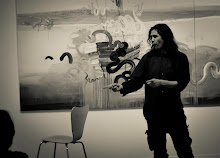
- matthew hammond
- This blog charts my attempts, in whatever way I can, and whenever I can, and as honestly as possible, to stand up for thinking - real thinking, whether in philosophy or politics, or maths - Because thinking needs standing up for!

Showing posts with label foucault. Show all posts
Showing posts with label foucault. Show all posts
Thursday, February 16, 2012

Friday, February 3, 2012
Stand up Philosophy: The power of ideas versus emotions - performance notes part s
There is an old truism, that one needs in thought to be very carful about emotions. Emotions lead one astray when one is thinking. They cloud thought, making you want to believe the untrue, or confuse the thought for the felt, as emotions form an intensity which feels like reality. This suspicion is well-founded; it was of such intense fears, and passions, that many a witch persecution is based. It is then no wonder that almost all philosophers, feeling themselves akin to witches, have lived in fear of the mob, and its collective passions: All the more so when the thinkers' ideas have often been untimely, problematic and complex. For how does one tell the collective believers they are not quite right, without becoming a figure of hate?
And yet this is only half the story. For what kind of passion motivates thinkers to think and act against the stream of public feeling? Is it really that they are following truth, pure and simple? And if so, is this not itself a passion? The answer surely is yes. What is more, it is a very singular passion, for it implies the thinker must have the courage to stand up against the mob, against what is currently 'normal' and thought right, a move which of course implies an even great passion for something, be it truth or posterity... To say that the philosopher should act dispassionately is therefore necessarily to miss the point. Most philosophers simply are passionate about something, - for why else write? What else is sustaining them as they sit in that closet, while the rain beats down and they think and write alone? Is it not that they are feeling the excitement of thinking and the urge to communicate those thoughts and the truths they open out on?
Moreover it is clear that passion that infuses their thought, in more diverse and complex ways, so much so that the relationship between the thinker and their passions is necessarily interesting in itself. For to think is of course to, in part, master one's passions, or perhaps better to endlessly reflect upon them. The result is essentially a patchwork of passion and thought. There are moments in every philosophy where the passion is not immediate, or hidden, or perhaps codified in the beauty or simple disruptiveness of an idea (think of Foucault's challenge to our ideas of sexuality here; a challenge that is passionate in the extreme, and yet expressed in logic). While at other times, the passion is allowed its head, in rhetorical flourishes or even sermons (think here of a Spinoza Scholium - little passionate essays that runs across his 'Ethics').
Finally many of the great philosophers are essentially vivisecting their own passions, and displaying the result. To read Spinoza's 'Ethics' or Nietzsche's 'Human all too Human', is to be taken close to the heart of a thinker, and their feelings. The power of the book lies in the way in which it allows you to understand the heart of its creator, and see in that heart echoes of one own being.
Philosophy is therefore caught is a very interesting and complex relationship with the feelings that infuse it, and yet which it must always clarify and reflect upon and through. A complex and often beautiful relationship, that is essentially the stuff of performance art. In showing the passion of thinkers, and how it infuses works of thought, one is both being true to the ideas of the thinker, but also their methodologies and motivations. For 'philosophy without passion is clearly a mistake'. What is more, these passions make great drama, and suck an audience of non-philosophers into a world some they thought they could never know, or perhaps otherwise experience: The world of thoughts and their passions, where philosophy really does mean 'love of knowledge'. A move that then allows the audience an entry point into philosophy, and new perhaps even offers them a new way to understand their own passions and their reaction to those passions.
And yet this is only half the story. For what kind of passion motivates thinkers to think and act against the stream of public feeling? Is it really that they are following truth, pure and simple? And if so, is this not itself a passion? The answer surely is yes. What is more, it is a very singular passion, for it implies the thinker must have the courage to stand up against the mob, against what is currently 'normal' and thought right, a move which of course implies an even great passion for something, be it truth or posterity... To say that the philosopher should act dispassionately is therefore necessarily to miss the point. Most philosophers simply are passionate about something, - for why else write? What else is sustaining them as they sit in that closet, while the rain beats down and they think and write alone? Is it not that they are feeling the excitement of thinking and the urge to communicate those thoughts and the truths they open out on?
Moreover it is clear that passion that infuses their thought, in more diverse and complex ways, so much so that the relationship between the thinker and their passions is necessarily interesting in itself. For to think is of course to, in part, master one's passions, or perhaps better to endlessly reflect upon them. The result is essentially a patchwork of passion and thought. There are moments in every philosophy where the passion is not immediate, or hidden, or perhaps codified in the beauty or simple disruptiveness of an idea (think of Foucault's challenge to our ideas of sexuality here; a challenge that is passionate in the extreme, and yet expressed in logic). While at other times, the passion is allowed its head, in rhetorical flourishes or even sermons (think here of a Spinoza Scholium - little passionate essays that runs across his 'Ethics').
Finally many of the great philosophers are essentially vivisecting their own passions, and displaying the result. To read Spinoza's 'Ethics' or Nietzsche's 'Human all too Human', is to be taken close to the heart of a thinker, and their feelings. The power of the book lies in the way in which it allows you to understand the heart of its creator, and see in that heart echoes of one own being.
Philosophy is therefore caught is a very interesting and complex relationship with the feelings that infuse it, and yet which it must always clarify and reflect upon and through. A complex and often beautiful relationship, that is essentially the stuff of performance art. In showing the passion of thinkers, and how it infuses works of thought, one is both being true to the ideas of the thinker, but also their methodologies and motivations. For 'philosophy without passion is clearly a mistake'. What is more, these passions make great drama, and suck an audience of non-philosophers into a world some they thought they could never know, or perhaps otherwise experience: The world of thoughts and their passions, where philosophy really does mean 'love of knowledge'. A move that then allows the audience an entry point into philosophy, and new perhaps even offers them a new way to understand their own passions and their reaction to those passions.
Thursday, February 2, 2012
Encounters with Philosophy as stand up: Part 2 - As difficult
One of the strange oddities about philosophy is its love affair with the difficult. And difficulty itself is such a tricky notion. There are three different senses in which philosophy is 'difficult', and only one of which is genuine.
First and most simply, philosophy likes to think of itself, and is thought as, 'difficult'. The motivation of course here is simple. If it is difficult then philosophers are clever - what is more, if it is difficult then the rest of the world need not bother with it at all. Philosophy becomes then a self-invented 'gold-standard' for knowledge. The course we put people on to prove we are serious in study. It becomes then, as it is sometimes taught (and often thought of ) as totally useless and self indulgent idiocy, whose main refrain is 'look at me, I am so very clever I am...I understand...': A feeling that might well be pretension, or might be honest, but either way misses the point. For me, the entire premise of stand up philosophy is that great ideas, even ones which are complicated in their language and subtle in the exposition, still have a power to move, to change the mind, to make one want to think differently. Philosophy however 'hard' has the power to intrigue, and opens on a poetry of possibly, which allows one to re-think one's own nature. Of course this move might in itself be 'difficult', in that it might involve much thought, and much self correction, however it should not feel it, in the same way that rhyming poetry should never feel artificial and forced. Philosophy should fascinate, delight, perhaps perplex, but always entice, and never feel difficult or impenetrable or even just mad.
The second a sense that philosophy is difficult lies in the fact that it does involve in itself a lot of study, and thought. And yet If the thinker is doing their job properly, the difficulty is more a problem of being time-consuming, rather than being 'hard'. Good philosophy takes time. That is of course rather difficult, it gets on the way of 'real life': But that requirement for scholarship in itself, does not make it 'difficult'. It merely says that the world cannot be immediately reacted to or understood - nor should it. Philosophy as stand up takes a certain position in this aspect of the difficult. Its job is to summarise years of study, to condense them into a performance, so that it should at once be highly textured, opening out on many layers, and shifting interpretations (with perhaps many voices), and yet not to ever drown in this knowledge. One must make the difficult feel natural, normal, even exciting. For as Socrates would say, what could be more exciting that being able to think, genuinely think for oneself? And good stand up makes you really want to think (and not merely argue or strop or simply react).
The final common use for the word difficult in this context is much harder to counter. Something is difficult if it makes the world difficult, edgy, not straight-forward. The difficult turns the world into a problem, and shatters easy had given solutions to that problem. A move, a making difficult, that philosophy, including as stand up, always claims as somehow peculiarly its own. The game is always to make that difficulty not feel hopeless or pointless. It might make the world more tricky, but the difficulty is worth it, or is at least worth trying. A move that is always difficult to make for every individual, but which which stand up philosophy hopes to inspire.
In short stand up is difficult because it makes one want to address the difficulty of the world, and should never be merely pointlessly 'hard'.
First and most simply, philosophy likes to think of itself, and is thought as, 'difficult'. The motivation of course here is simple. If it is difficult then philosophers are clever - what is more, if it is difficult then the rest of the world need not bother with it at all. Philosophy becomes then a self-invented 'gold-standard' for knowledge. The course we put people on to prove we are serious in study. It becomes then, as it is sometimes taught (and often thought of ) as totally useless and self indulgent idiocy, whose main refrain is 'look at me, I am so very clever I am...I understand...': A feeling that might well be pretension, or might be honest, but either way misses the point. For me, the entire premise of stand up philosophy is that great ideas, even ones which are complicated in their language and subtle in the exposition, still have a power to move, to change the mind, to make one want to think differently. Philosophy however 'hard' has the power to intrigue, and opens on a poetry of possibly, which allows one to re-think one's own nature. Of course this move might in itself be 'difficult', in that it might involve much thought, and much self correction, however it should not feel it, in the same way that rhyming poetry should never feel artificial and forced. Philosophy should fascinate, delight, perhaps perplex, but always entice, and never feel difficult or impenetrable or even just mad.
The second a sense that philosophy is difficult lies in the fact that it does involve in itself a lot of study, and thought. And yet If the thinker is doing their job properly, the difficulty is more a problem of being time-consuming, rather than being 'hard'. Good philosophy takes time. That is of course rather difficult, it gets on the way of 'real life': But that requirement for scholarship in itself, does not make it 'difficult'. It merely says that the world cannot be immediately reacted to or understood - nor should it. Philosophy as stand up takes a certain position in this aspect of the difficult. Its job is to summarise years of study, to condense them into a performance, so that it should at once be highly textured, opening out on many layers, and shifting interpretations (with perhaps many voices), and yet not to ever drown in this knowledge. One must make the difficult feel natural, normal, even exciting. For as Socrates would say, what could be more exciting that being able to think, genuinely think for oneself? And good stand up makes you really want to think (and not merely argue or strop or simply react).
The final common use for the word difficult in this context is much harder to counter. Something is difficult if it makes the world difficult, edgy, not straight-forward. The difficult turns the world into a problem, and shatters easy had given solutions to that problem. A move, a making difficult, that philosophy, including as stand up, always claims as somehow peculiarly its own. The game is always to make that difficulty not feel hopeless or pointless. It might make the world more tricky, but the difficulty is worth it, or is at least worth trying. A move that is always difficult to make for every individual, but which which stand up philosophy hopes to inspire.
In short stand up is difficult because it makes one want to address the difficulty of the world, and should never be merely pointlessly 'hard'.
Sunday, January 29, 2012
Encounters with Philosophy as standup: Part 1 as Demonology
Deleuze says somewhere in 'Difference and Repetition', that Philosophy is all about encounters with Demons. To meet a philosopher adequately is to be taken on a witch ride, transforming your thought, allowing you to think differently, or at least to understand how you are already thinking differently. A maxim that is even more true when the philosopher one encounters is firmly 'part of the history' of philosophy. For history has its own power to create in us, thought. To study a past thinker is therefore not just to encounter their actual thought, but also the echoes and cadences of their thought today. So that one encounters both how these ideas affected subsequent thought, and so informed (or not) our thinking. And also how the debates, circumstances, and experiences that created the original thought find echoes in today's event. Repetitions that allow one both to understand the original afresh, but also in the process, allow different ways to comprehend what is happening now.
Demons, which merge past and present, and shift one's understanding of the future, are the stuff of the history of philosophy. A discipline that asks us to understand how the concepts and experiences that populate and mould our minds were originally not our own, and are never simply truly 'ours' alone. The material of stand up philosophy places one in a curious place. One is drawing on the works from the history of thought, and so in a sense running up against, and conjuring up these worldly demons, and one's performance must reflect that. At some point, there must be a feeling that something is breaking through or breaking out, a feeling of shifting, being challenged, where one is risking something possibly precious, and we are not sure what we will gain in return.
This much perhaps could be said of all performance art. But what makes Stand up Philosophy a little different is that the rhythm of the performance, is caught up very directly with the ideas one is communicating. Ideas are therefore not lurking beyond the performance or underlying it, but are very much centre stage, and the performance must echo, and reflect the 'demonic' lines by which the ideas reach back into the past, but also into our minds, and the way in which we grope towards a future. Good stand up philosophy orchestrates this thought by any means, be it by humour or audience participation, poetry or tragedy.
To perform philosophy, is therefore to allow an idea to really be understood for what it is. Ideas are not something there to be thought and done with, understood and so completed. They are rather strange pathways blending any times and multiple problems, making demons of and in all of us. For the history of philosophy done properly is really a demonology, and to perform it, an act of evocation.
Demons, which merge past and present, and shift one's understanding of the future, are the stuff of the history of philosophy. A discipline that asks us to understand how the concepts and experiences that populate and mould our minds were originally not our own, and are never simply truly 'ours' alone. The material of stand up philosophy places one in a curious place. One is drawing on the works from the history of thought, and so in a sense running up against, and conjuring up these worldly demons, and one's performance must reflect that. At some point, there must be a feeling that something is breaking through or breaking out, a feeling of shifting, being challenged, where one is risking something possibly precious, and we are not sure what we will gain in return.
This much perhaps could be said of all performance art. But what makes Stand up Philosophy a little different is that the rhythm of the performance, is caught up very directly with the ideas one is communicating. Ideas are therefore not lurking beyond the performance or underlying it, but are very much centre stage, and the performance must echo, and reflect the 'demonic' lines by which the ideas reach back into the past, but also into our minds, and the way in which we grope towards a future. Good stand up philosophy orchestrates this thought by any means, be it by humour or audience participation, poetry or tragedy.
To perform philosophy, is therefore to allow an idea to really be understood for what it is. Ideas are not something there to be thought and done with, understood and so completed. They are rather strange pathways blending any times and multiple problems, making demons of and in all of us. For the history of philosophy done properly is really a demonology, and to perform it, an act of evocation.
Subscribe to:
Posts (Atom)