One of the features of philosophy, written or performed, is its relationship with its authors. In a sense every written discipline conjures up and then possibly kills its non-present author, in a whole variety of ways.
For example, both drama and novels exist as the progeny of their author. A Shakespeare play or a Dickens' novel is essentially part of a tribe, whose badge is the name and all it implies, of their distant author or parent. Each work reflects their parent's concerns, while being a thing in its own right. Moreover each work is bought into a relationship with all the other works of the same author, good or bad, short or long, comedy or drama. They all jostle together as siblings reflecting and refracting each other's themes, and ideas, but always each doing so in its own way, while others look on and choose their favourite...
Alternatively science, in the name of constants or formulae or laws, treat the name of their founder or first observer almost as an impresario. One talks then of Newton's laws of motion, as if he was the one who had realized their production. Which in a sense of course he was. It was his genius after all that cleared the way, that defined the stage in which the laws function, and through which they might be observed. In a similar vain, Einstein 'arranges' relativity and opens our minds not only to different ways of producing thoughts about the natural word, but also, that in the form of new experiments, endless new little possible dramas. (For experiments can be very dramatic.)
Philosopher's names are again different. For philosophy almost at its outset, used the names of others to explore thought, calling them up as if they were familiar spirits or demons, or wearing them as dramatic masks. Hence Plato called upon the voice, mask, and so ideas of Socrates to explain his thinking, while Kant wrestled with a Hume whose ideas he felt he needed to counter. Philosophers therefore enter the mind as a way of thought, a set of assumptions and moves, or ideas and observations, that are then treated as something in themselves. The power of a philosopher's ideas lies in their power to allow others to don the mask of their thinker, and to use those ideas to create new thoughts of their own. An idea is good in philosophy if it can take over, and run across the minds of very many other thinkers, and infuse many other ideas.
It is this feature of philosophy that works so very well as Stand up. One is always, in different ways, conjuring with another's ideas. To perform philosophy is to show exactly how and why philosophy works as it does. That is, it is to show how thinking with another's ideas actually allows and develops new thought. And even more importantly, stand up hopes to communicate how that curious state that develops in the mind of the student of philosophy, where they are no longer sure where their thoughts begin, and another's end, is so creative and so powerful. It is this 'in between space', where ideas are shared, and developed, held in common, and so transformed, that defines philosophy; but also perhaps ironically, which makes good stand up, which likewise revolves around a collective reacting to an idea or phrase or perhaps experience. It follows that done properly, stand up philosophy ought to be very real philosophy, for the sharing of ideas between the living and the dead and the creation of odd interpersonal thoughts that necessarily follow, is the stuff of philosophy itself, and the source of some of its power. So that essentially, philosophy is performance, it is always the sharing of ideas attached to philosopher-actors, and it is this vitality, this hidden drama, which stand up exploits and feeds upon, and hopes to communicate.
What is Stand Up Philosophy
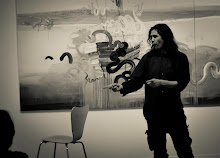
- matthew hammond
- This blog charts my attempts, in whatever way I can, and whenever I can, and as honestly as possible, to stand up for thinking - real thinking, whether in philosophy or politics, or maths - Because thinking needs standing up for!

Showing posts with label thought. Show all posts
Showing posts with label thought. Show all posts
Tuesday, February 7, 2012

Thursday, February 2, 2012
Encounters with Philosophy as stand up: Part 2 - As difficult
One of the strange oddities about philosophy is its love affair with the difficult. And difficulty itself is such a tricky notion. There are three different senses in which philosophy is 'difficult', and only one of which is genuine.
First and most simply, philosophy likes to think of itself, and is thought as, 'difficult'. The motivation of course here is simple. If it is difficult then philosophers are clever - what is more, if it is difficult then the rest of the world need not bother with it at all. Philosophy becomes then a self-invented 'gold-standard' for knowledge. The course we put people on to prove we are serious in study. It becomes then, as it is sometimes taught (and often thought of ) as totally useless and self indulgent idiocy, whose main refrain is 'look at me, I am so very clever I am...I understand...': A feeling that might well be pretension, or might be honest, but either way misses the point. For me, the entire premise of stand up philosophy is that great ideas, even ones which are complicated in their language and subtle in the exposition, still have a power to move, to change the mind, to make one want to think differently. Philosophy however 'hard' has the power to intrigue, and opens on a poetry of possibly, which allows one to re-think one's own nature. Of course this move might in itself be 'difficult', in that it might involve much thought, and much self correction, however it should not feel it, in the same way that rhyming poetry should never feel artificial and forced. Philosophy should fascinate, delight, perhaps perplex, but always entice, and never feel difficult or impenetrable or even just mad.
The second a sense that philosophy is difficult lies in the fact that it does involve in itself a lot of study, and thought. And yet If the thinker is doing their job properly, the difficulty is more a problem of being time-consuming, rather than being 'hard'. Good philosophy takes time. That is of course rather difficult, it gets on the way of 'real life': But that requirement for scholarship in itself, does not make it 'difficult'. It merely says that the world cannot be immediately reacted to or understood - nor should it. Philosophy as stand up takes a certain position in this aspect of the difficult. Its job is to summarise years of study, to condense them into a performance, so that it should at once be highly textured, opening out on many layers, and shifting interpretations (with perhaps many voices), and yet not to ever drown in this knowledge. One must make the difficult feel natural, normal, even exciting. For as Socrates would say, what could be more exciting that being able to think, genuinely think for oneself? And good stand up makes you really want to think (and not merely argue or strop or simply react).
The final common use for the word difficult in this context is much harder to counter. Something is difficult if it makes the world difficult, edgy, not straight-forward. The difficult turns the world into a problem, and shatters easy had given solutions to that problem. A move, a making difficult, that philosophy, including as stand up, always claims as somehow peculiarly its own. The game is always to make that difficulty not feel hopeless or pointless. It might make the world more tricky, but the difficulty is worth it, or is at least worth trying. A move that is always difficult to make for every individual, but which which stand up philosophy hopes to inspire.
In short stand up is difficult because it makes one want to address the difficulty of the world, and should never be merely pointlessly 'hard'.
First and most simply, philosophy likes to think of itself, and is thought as, 'difficult'. The motivation of course here is simple. If it is difficult then philosophers are clever - what is more, if it is difficult then the rest of the world need not bother with it at all. Philosophy becomes then a self-invented 'gold-standard' for knowledge. The course we put people on to prove we are serious in study. It becomes then, as it is sometimes taught (and often thought of ) as totally useless and self indulgent idiocy, whose main refrain is 'look at me, I am so very clever I am...I understand...': A feeling that might well be pretension, or might be honest, but either way misses the point. For me, the entire premise of stand up philosophy is that great ideas, even ones which are complicated in their language and subtle in the exposition, still have a power to move, to change the mind, to make one want to think differently. Philosophy however 'hard' has the power to intrigue, and opens on a poetry of possibly, which allows one to re-think one's own nature. Of course this move might in itself be 'difficult', in that it might involve much thought, and much self correction, however it should not feel it, in the same way that rhyming poetry should never feel artificial and forced. Philosophy should fascinate, delight, perhaps perplex, but always entice, and never feel difficult or impenetrable or even just mad.
The second a sense that philosophy is difficult lies in the fact that it does involve in itself a lot of study, and thought. And yet If the thinker is doing their job properly, the difficulty is more a problem of being time-consuming, rather than being 'hard'. Good philosophy takes time. That is of course rather difficult, it gets on the way of 'real life': But that requirement for scholarship in itself, does not make it 'difficult'. It merely says that the world cannot be immediately reacted to or understood - nor should it. Philosophy as stand up takes a certain position in this aspect of the difficult. Its job is to summarise years of study, to condense them into a performance, so that it should at once be highly textured, opening out on many layers, and shifting interpretations (with perhaps many voices), and yet not to ever drown in this knowledge. One must make the difficult feel natural, normal, even exciting. For as Socrates would say, what could be more exciting that being able to think, genuinely think for oneself? And good stand up makes you really want to think (and not merely argue or strop or simply react).
The final common use for the word difficult in this context is much harder to counter. Something is difficult if it makes the world difficult, edgy, not straight-forward. The difficult turns the world into a problem, and shatters easy had given solutions to that problem. A move, a making difficult, that philosophy, including as stand up, always claims as somehow peculiarly its own. The game is always to make that difficulty not feel hopeless or pointless. It might make the world more tricky, but the difficulty is worth it, or is at least worth trying. A move that is always difficult to make for every individual, but which which stand up philosophy hopes to inspire.
In short stand up is difficult because it makes one want to address the difficulty of the world, and should never be merely pointlessly 'hard'.
Sunday, January 29, 2012
Encounters with Philosophy as standup: Part 1 as Demonology
Deleuze says somewhere in 'Difference and Repetition', that Philosophy is all about encounters with Demons. To meet a philosopher adequately is to be taken on a witch ride, transforming your thought, allowing you to think differently, or at least to understand how you are already thinking differently. A maxim that is even more true when the philosopher one encounters is firmly 'part of the history' of philosophy. For history has its own power to create in us, thought. To study a past thinker is therefore not just to encounter their actual thought, but also the echoes and cadences of their thought today. So that one encounters both how these ideas affected subsequent thought, and so informed (or not) our thinking. And also how the debates, circumstances, and experiences that created the original thought find echoes in today's event. Repetitions that allow one both to understand the original afresh, but also in the process, allow different ways to comprehend what is happening now.
Demons, which merge past and present, and shift one's understanding of the future, are the stuff of the history of philosophy. A discipline that asks us to understand how the concepts and experiences that populate and mould our minds were originally not our own, and are never simply truly 'ours' alone. The material of stand up philosophy places one in a curious place. One is drawing on the works from the history of thought, and so in a sense running up against, and conjuring up these worldly demons, and one's performance must reflect that. At some point, there must be a feeling that something is breaking through or breaking out, a feeling of shifting, being challenged, where one is risking something possibly precious, and we are not sure what we will gain in return.
This much perhaps could be said of all performance art. But what makes Stand up Philosophy a little different is that the rhythm of the performance, is caught up very directly with the ideas one is communicating. Ideas are therefore not lurking beyond the performance or underlying it, but are very much centre stage, and the performance must echo, and reflect the 'demonic' lines by which the ideas reach back into the past, but also into our minds, and the way in which we grope towards a future. Good stand up philosophy orchestrates this thought by any means, be it by humour or audience participation, poetry or tragedy.
To perform philosophy, is therefore to allow an idea to really be understood for what it is. Ideas are not something there to be thought and done with, understood and so completed. They are rather strange pathways blending any times and multiple problems, making demons of and in all of us. For the history of philosophy done properly is really a demonology, and to perform it, an act of evocation.
Demons, which merge past and present, and shift one's understanding of the future, are the stuff of the history of philosophy. A discipline that asks us to understand how the concepts and experiences that populate and mould our minds were originally not our own, and are never simply truly 'ours' alone. The material of stand up philosophy places one in a curious place. One is drawing on the works from the history of thought, and so in a sense running up against, and conjuring up these worldly demons, and one's performance must reflect that. At some point, there must be a feeling that something is breaking through or breaking out, a feeling of shifting, being challenged, where one is risking something possibly precious, and we are not sure what we will gain in return.
This much perhaps could be said of all performance art. But what makes Stand up Philosophy a little different is that the rhythm of the performance, is caught up very directly with the ideas one is communicating. Ideas are therefore not lurking beyond the performance or underlying it, but are very much centre stage, and the performance must echo, and reflect the 'demonic' lines by which the ideas reach back into the past, but also into our minds, and the way in which we grope towards a future. Good stand up philosophy orchestrates this thought by any means, be it by humour or audience participation, poetry or tragedy.
To perform philosophy, is therefore to allow an idea to really be understood for what it is. Ideas are not something there to be thought and done with, understood and so completed. They are rather strange pathways blending any times and multiple problems, making demons of and in all of us. For the history of philosophy done properly is really a demonology, and to perform it, an act of evocation.
Friday, January 27, 2012
Why perform Philosophy - part 2
Beyond my personal reasons for performing philosophy, there are a number of substantive reasons why it works so well. Firstly a large and very important part of the philosophical canon was, and in a sense still is, essentially oral. Before printing, ideas which resonated, which worked, had to be those which not only passed from book to book, but also lingered in the memory. Think of Plato's style, of the fact that we have Aristotle's lectures notes, or the lecture stylistics of Plotinus. Philosophy was then always, like so much of ancient culture, a game of speaking, thinking and remembering, and doing it is as stand up or performance is merely recalling that fact.
But there is a second very deep reason why Philosophy works as 'stand up', which goes close to the heart of my understanding of the discipline. It has always seemed to be, that most truly great philosophical ideas are actually rather simple in essence. They might mangle the mind, and make you re-think how you understand what you are, but the idea itself is very simple, and often quite succinct. It can therefore be taken succinctly from the context of a book, and presented as a thing in itself, as an idea that people will encounter, to surprise and delight.
But there are other reasons why Philosophy works as performance, great philosophers are, as Deleuze said, great stylists. They are re-working language, forging a word hoard of their own, and you can actually hear them do it as you perform them. Whether it is in the form of the great opener, or ending, or slips in words or quiet and complex or even evolving repetitions, all make their presence felt, and add to the performance. In a sense this is only natural, one is after all performing some of the finest material ever written.
Finally, albeit in a subtle way, great philosophy is great drama or perhaps comedy. Philosophy is after all, quite literally mind changing, and what is more dramatic than that? Moreover great works of philosophy often represent moments in a crisis, be that its onslaught or its resolution. They are therefore in a sense naturally dramatic, a drama that establishes odd connections between some of the deep assumptions of our own mind, and the personal histories and individual crises, of the thinkers, whose ideas laid down those assumptions. What we take as natural and so obvious, is seen differently, as an idea that is new and heartfelt, or perhaps agonising, or beautiful, or even ridiculous. Stand up philosophy opens us up to a drama we are still part of, and throws light on our place in it, as both audience but also as modern actors.
Or to put it another way, Philosophy is essentially dramatic - and stand up philosophy merely surfs that fact.
But there is a second very deep reason why Philosophy works as 'stand up', which goes close to the heart of my understanding of the discipline. It has always seemed to be, that most truly great philosophical ideas are actually rather simple in essence. They might mangle the mind, and make you re-think how you understand what you are, but the idea itself is very simple, and often quite succinct. It can therefore be taken succinctly from the context of a book, and presented as a thing in itself, as an idea that people will encounter, to surprise and delight.
But there are other reasons why Philosophy works as performance, great philosophers are, as Deleuze said, great stylists. They are re-working language, forging a word hoard of their own, and you can actually hear them do it as you perform them. Whether it is in the form of the great opener, or ending, or slips in words or quiet and complex or even evolving repetitions, all make their presence felt, and add to the performance. In a sense this is only natural, one is after all performing some of the finest material ever written.
Finally, albeit in a subtle way, great philosophy is great drama or perhaps comedy. Philosophy is after all, quite literally mind changing, and what is more dramatic than that? Moreover great works of philosophy often represent moments in a crisis, be that its onslaught or its resolution. They are therefore in a sense naturally dramatic, a drama that establishes odd connections between some of the deep assumptions of our own mind, and the personal histories and individual crises, of the thinkers, whose ideas laid down those assumptions. What we take as natural and so obvious, is seen differently, as an idea that is new and heartfelt, or perhaps agonising, or beautiful, or even ridiculous. Stand up philosophy opens us up to a drama we are still part of, and throws light on our place in it, as both audience but also as modern actors.
Or to put it another way, Philosophy is essentially dramatic - and stand up philosophy merely surfs that fact.
Thursday, January 26, 2012
What made you a stand up philosopher?
" Time bought me here "
The idea of stand up philosophy was born really from three things.
Firstly and most deeply, running through my show is my simple love for philosophy and for the problems it asks. Most particularly I love thought when it challenges our expectations about what the world is - be it our perceptions of the importance of Time or the balance of perception and reality, or the idea of freedom, philosophy has much to ask of us, and much to challenge us with. To perform philosophy is therefore to liberate some of the most powerful of ideas, and beautifully written intense words, from their traditional scholarly context, and introduce them into new contexts, so that many can feel their force and challenge.
Secondly the idea of stand up philosophy has appealed to me because of my own rather unique circumstances. I have a 'condition' which was, say thirty years ago, called mild dyslexia, but had by twenty years ago become severe dyslexia (although I has remained the same) and then changed by some odd 'medical' metamorphosis, a decade ago or so to 'Dyspraxia', before finally dropping off all scales, and the spectrum, to become what it always was - an oddity (which actually was a great relief). Suffice it to say that between my thoughts and my fingers a strange miasma exists. So that however clear an idea is in my head, and however subtle the way I think I am writing it is, however nuanced, and intricate, what actually appears on the page has spelling that would disgrace an eleven year old and far more critically, grammar that at times would disgrace an infant school. While at the same time, every piece of paper I lay my hands on ends up crumpled... All of which means means I do not really fit in neatly with traditional academia, which perfectly naturally, tends to judge on the written word, and to be somewhat suspicious of the spoken.
Finally, partly perhaps because of the dyslexia, I have always loved teaching, and presenting ideas so that everyone or any one can get something out of them, and have the chance to use them. Professionally I teach maths, but always, in my brief university career, loved teaching philosophy, and the show was a natural extension of that love. It just felt right, to still be presenting the ideas and thoughts I valued most... a feeling that was confirmed both when I started my stand up routine and when a very wide variety of audiences seemed to really engage with the show, which then developed to include more and more philosophy, but also became more varied, as the routines included some performances which drew upon my other storytelling / dramatic shows.
The result is a show that is I hope at once true to philosophical roots, but highly varied and engaging performances, from clear expositions of complex ideas, through to dramatic and powerful renditions of a philosophy, or perhaps the moment the philosopher suddenly had 'THAT IDEA', to crowd-pleasing, audience-participation, storytelling style pieces which remain quirkily thoughtful, and surprisingly complex. A sequence of performances and styles which create a show which I hope straddles many divides and is capable at once of making professional philosophers smile, while it engages those who have a passing knowledge of the ideas, and intrigues and encourages the lay person, but above all, and at all levels remains splendid entertainment.
The idea of stand up philosophy was born really from three things.
Firstly and most deeply, running through my show is my simple love for philosophy and for the problems it asks. Most particularly I love thought when it challenges our expectations about what the world is - be it our perceptions of the importance of Time or the balance of perception and reality, or the idea of freedom, philosophy has much to ask of us, and much to challenge us with. To perform philosophy is therefore to liberate some of the most powerful of ideas, and beautifully written intense words, from their traditional scholarly context, and introduce them into new contexts, so that many can feel their force and challenge.
Secondly the idea of stand up philosophy has appealed to me because of my own rather unique circumstances. I have a 'condition' which was, say thirty years ago, called mild dyslexia, but had by twenty years ago become severe dyslexia (although I has remained the same) and then changed by some odd 'medical' metamorphosis, a decade ago or so to 'Dyspraxia', before finally dropping off all scales, and the spectrum, to become what it always was - an oddity (which actually was a great relief). Suffice it to say that between my thoughts and my fingers a strange miasma exists. So that however clear an idea is in my head, and however subtle the way I think I am writing it is, however nuanced, and intricate, what actually appears on the page has spelling that would disgrace an eleven year old and far more critically, grammar that at times would disgrace an infant school. While at the same time, every piece of paper I lay my hands on ends up crumpled... All of which means means I do not really fit in neatly with traditional academia, which perfectly naturally, tends to judge on the written word, and to be somewhat suspicious of the spoken.
Finally, partly perhaps because of the dyslexia, I have always loved teaching, and presenting ideas so that everyone or any one can get something out of them, and have the chance to use them. Professionally I teach maths, but always, in my brief university career, loved teaching philosophy, and the show was a natural extension of that love. It just felt right, to still be presenting the ideas and thoughts I valued most... a feeling that was confirmed both when I started my stand up routine and when a very wide variety of audiences seemed to really engage with the show, which then developed to include more and more philosophy, but also became more varied, as the routines included some performances which drew upon my other storytelling / dramatic shows.
The result is a show that is I hope at once true to philosophical roots, but highly varied and engaging performances, from clear expositions of complex ideas, through to dramatic and powerful renditions of a philosophy, or perhaps the moment the philosopher suddenly had 'THAT IDEA', to crowd-pleasing, audience-participation, storytelling style pieces which remain quirkily thoughtful, and surprisingly complex. A sequence of performances and styles which create a show which I hope straddles many divides and is capable at once of making professional philosophers smile, while it engages those who have a passing knowledge of the ideas, and intrigues and encourages the lay person, but above all, and at all levels remains splendid entertainment.
Subscribe to:
Posts (Atom)